Key Takeaways
- The Widow-Maker: Dead branches caught in the canopy are the #1 cause of sudden property damage and injury.
- V-Shaped Unions: Co-dominant stems with “included bark” are structurally weaker than single-trunk trees.
- Fungal Red Flags: Mushrooms at the base of a tree often indicate internal root rot that isn’t visible to the naked eye.
- Early Detection: Identifying “cracks and cankers” early can often allow for cabling or bracing rather than full removal.
For homeowners in Burlington, Muskego, and Lake Geneva, our trees are more than just landscape features; they are massive structures weighing several tons. While a mature Oak or Maple provides beauty and shade, it also presents a significant liability if its structural integrity is compromised.
In Southeast Wisconsin, where heavy “ice-shoving” winds and violent summer squalls are common, a tree that looks healthy from a distance may actually be a “ticking time bomb.” Understanding how to perform a basic visual safety audit of your trees can be the difference between a routine pruning and an insurance claim for a crushed roof.
1. The Canopy Check: Identifying “Widow-Makers”
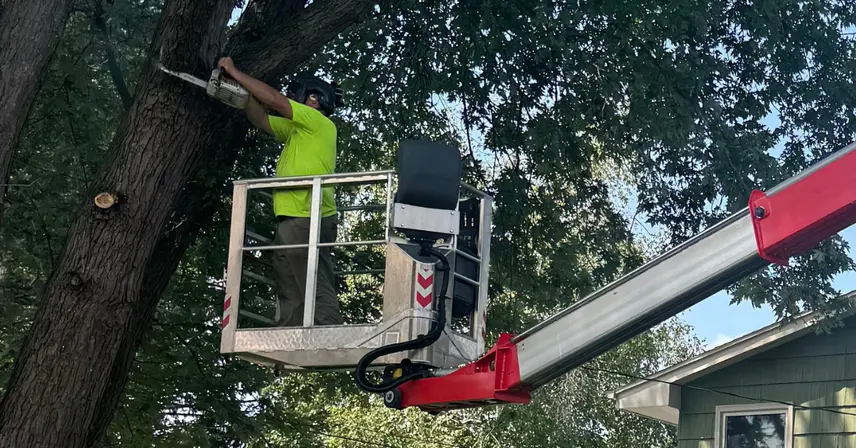
The most immediate hazard on any property is the presence of dead wood, specifically “widow-makers”, large dead branches that have snapped but are still caught in the upper canopy.
- Color and Texture: Look for branches that lack bark or have a significantly different color than the rest of the tree. Dead wood often appears gray and brittle.
- The Hanger: If a branch is resting on other limbs rather than being attached to the trunk, it is an immediate emergency. Gravity, wind, or the weight of snow will eventually bring it down.
- Missing Buds: In the spring and summer, any branch that fails to produce leaves or buds while the rest of the tree is lush is dead and should be assessed for removal.
2. The Trunk Audit: Cracks, Cavities, and Cankers
The trunk is the “pillar” of your tree’s structure. Any compromise here affects the stability of the entire organism.
- Vertical Cracks: Deep, vertical splits that go through the bark and into the wood are signs of internal stress. These are particularly dangerous if there are two cracks on opposite sides of the trunk.
- Cankers: These are localized areas of dead bark or open sores. While they might look minor, they weaken the “shell” of the tree, making it prone to snapping at that specific point.
- Cavities: Large holes in the trunk often indicate internal decay. While a tree can live for years with a hollow center, its structural “safety factor” is significantly reduced during high-wind events.
3. V-Shaped Unions: The Weakest Link
One of the most common structural defects we see in Southeast Wisconsin is co-dominant stems. This occurs when a tree grows two or more main trunks that are roughly the same size.
- Included Bark: If the union between two trunks looks like a tight “V” rather than a wide “U,” the bark is likely growing inward. This prevents the two stems from physically bonding together. As the trunks grow larger, they literally push each other apart until one eventually splits off during a storm.
4. Root Zone Hazards: The Invisible Foundation
Because we can’t see the roots, we often ignore the most critical part of tree stability. In the heavy clay soils of Walworth County, root issues are a leading cause of entire trees “toppling” (root failure).
- Fungal Conks: If you see shelf-like mushrooms growing at the base of the tree or on the flare of the roots, it’s a sign of wood-decaying fungi. This indicates that the roots or the “buttress” of the tree is rotting from the inside out.
- Soil Heaving: If the soil on one side of the tree is lifting or mounding, it’s a sign that the root plate is pulling out of the ground. This usually means the tree is in the process of leaning or falling.
Secure Your Property with Rausch Tree & Outdoor Services
Identifying a hazard is the first step, but resolving it safely requires specialized rigging and an arborist’s expertise. Rausch Tree & Outdoor Services specializes in comprehensive tree inspections and risk evaluations across Burlington and the surrounding communities. Whether you have a precarious “widow-maker” that needs tree trimming or a co-dominant stem that requires emergency tree removal, Caleb and his team provide the heavy-machinery expertise and military-grade precision to handle the job safely. As a veteran-owned local business, we prioritize the safety of your home and family above all else.
Don’t wait for the next storm to test your tree’s strength. Call or text Caleb at (262) 800-4471 for a free structural evaluation today.
Frequently Asked Questions
1. Can a tree with a hollow trunk be saved?
Often, yes. Trees grow in a “cylinder” of strength; as long as the outer shell of healthy wood is thick enough, the tree can remain stable. However, an arborist must measure the “shell thickness” to determine if it’s safe.
2. Is a leaning tree always a hazard?
Not necessarily. Trees that have grown at an angle to find sunlight are often structurally sound. However, a tree that recently started leaning is a major red flag for root failure.
3. Will removing a dead branch save the rest of the tree?
Yes. Removing dead wood prevents decay from spreading into the main trunk and reduces the “wind sail” effect, making the tree less likely to blow over in a storm.
4. Can V-shaped trunks be fixed without cutting the tree down?
In many cases, we can use cabling and bracing. By installing high-strength steel cables in the upper canopy, we can support the stems and prevent them from splitting apart.
5. Why are mushrooms at the base of my tree a problem?
Mushrooms are the “fruit” of a fungus. If they are growing on the tree, the fungus is already deep inside the wood fibers, eating away at the structural cellulose that keeps the tree standing.
6. Does heavy snow make dead branches more dangerous?
Absolutely. Dead wood is brittle and lacks the flexibility of living tissue. The “live load” of heavy Wisconsin snow can easily snap a dead limb that survived the summer winds.
7. How often should I have my trees inspected?
We recommend a professional safety audit every 2–3 years, or immediately following any major storm event with winds exceeding 50 mph.
Conclusion
Structural issues in trees are often subtle until they become catastrophic. By keeping an eye out for “widow-makers,” V-shaped unions, and fungal growth, you can act before the weather decides for you.
Whether it’s through precision pruning to lighten a top-heavy canopy or a safe, controlled removal of a decayed trunk, the team at Rausch Tree & Outdoor Services is dedicated to keeping the landscapes of Southeast Wisconsin safe, beautiful, and resilient.
Reviewed by a Certified Arborist
This EAB risk analysis has been reviewed to ensure all information regarding insect life cycles, soil mechanics, and tree failure standards meets the criteria of the International Society of Arboriculture (ISA).
Author Bio: Caleb Rausch, Tree Care Specialist
Caleb Rausch is the owner of Rausch Tree & Outdoor Services and a dedicated Private First Class in the Wisconsin Army National Guard. A Burlington native with roots in local dairy farming and the Lightweight Infantry, he combines a veteran’s discipline with a lifelong “boots-on-the-ground” work ethic to provide Southeast Wisconsin homeowners with precise tree health management and safe, high-stakes removals.